Delhi has always been at the heart of India’s road network, but with rapid urban growth, its roads have struggled under the pressure of ever-increasing traffic. To address this, the government has rolled out the Urban Extension Road-II (UER-II)—a project that promises to transform the way people travel in and around the National Capital Region (NCR).
What is UER-II?
The Urban Extension Road-II (UER-II) is a 75-kilometre access-controlled expressway built as part of the Delhi Master Plan to improve outer connectivity. Think of it as a semi-ring road around Delhi, designed to link the capital with key national highways while reducing pressure on the city’s overcrowded arterial roads.
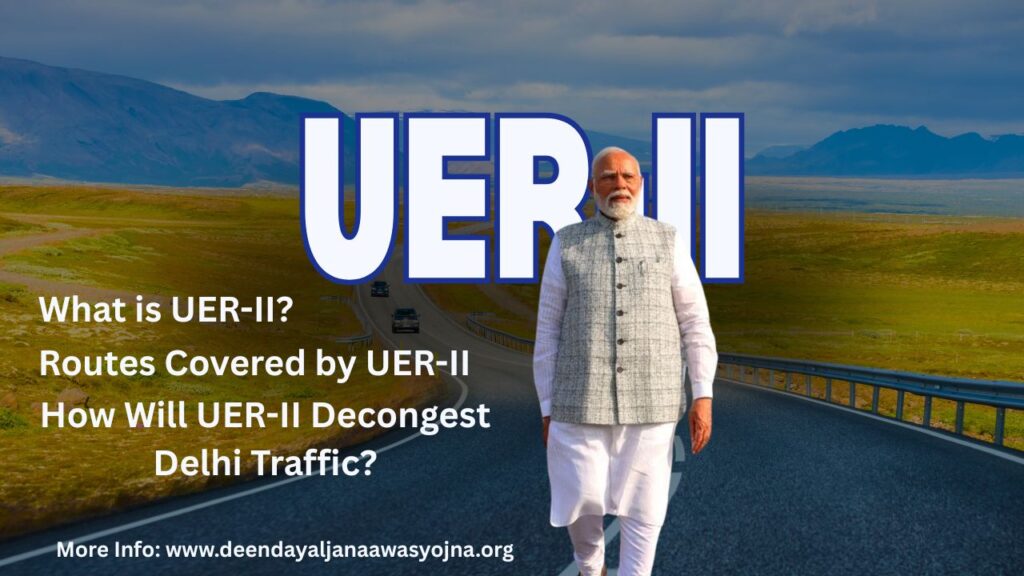
The project has been developed at a cost of around ₹11,000 crore and is being hailed as one of Delhi’s most significant road infrastructure upgrades in recent years.
Routes Covered by UER-II
UER-II is strategically designed to connect multiple highways and outer zones of Delhi. Here’s how it is planned:
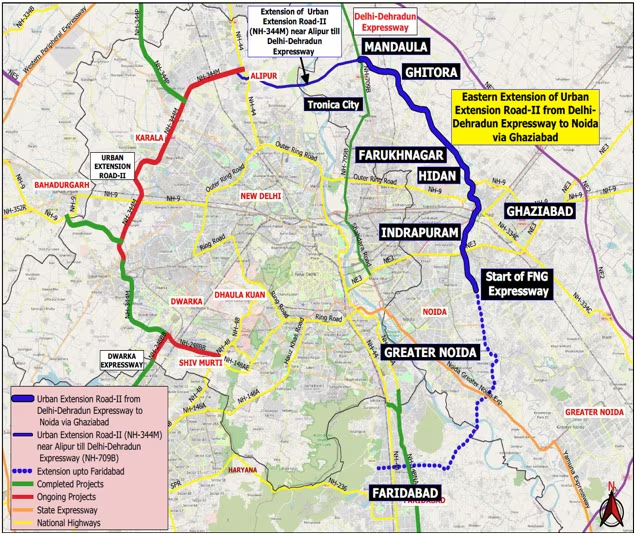
- Northern Delhi (Alipur) → starting point, connecting with NH-44 (towards Panipat and Sonipat).
- Passes through Rohini, Mundka, Najafgarh, and Dwarka.
- Links to Mahipalpur near IGI Airport, connecting further to NH-48 (Delhi–Gurgaon–Jaipur Highway).
- Spurs also extend towards Bahadurgarh and Sonipat, strengthening connectivity with Haryana towns. In simple terms: UER-II acts as a fast, outer bypass for Delhi, helping vehicles move between highways without entering the city.
How Will UER-II Decongest Delhi Traffic?
- Bypassing City Roads
- Currently, trucks and long-distance vehicles pass through Delhi to connect northern and southern highways, creating jams.
- With UER-II, heavy vehicles can bypass the city entirely, reducing congestion inside Delhi.
- Relief for Commuters
- Daily commuters between Dwarka, Rohini, Narela, Bahadurgarh, and Gurugram will save significant travel time.
- For example, reaching IGI Airport from Bahadurgarh could drop from nearly 2 hours to just 20–25 minutes.
- Supporting Dwarka Expressway & Peripheral Roads
- UER-II complements the Dwarka Expressway, creating a powerful road network that distributes traffic efficiently across NCR.
- 4. Pollution Control
- With smoother traffic flow and fewer idling vehicles stuck in jams, the project will also contribute to lower vehicular emissions, improving Delhi’s air quality.
Why UER-II Matters
- Time Savings → Faster connectivity to highways, airports, and satellite towns.
- Economic Growth → Boosts logistics, warehousing, and industrial activity along its corridor.
- Real Estate Potential → Opens new investment opportunities in Dwarka, Rohini, Narela, and Bahadurgarh.
- Better Quality of Life → Less congestion, shorter commutes, and reduced stress for Delhi NCR residents.
Final Word
The UER-II project isn’t just another road—it’s a game-changer for Delhi NCR. By acting as a lifeline that eases traffic pressure, improves logistics, and opens new growth corridors, it is set to redefine how Delhi moves in the years to come. For commuters, businesses, and investors alike, UER-II is the start of a more connected, efficient, and livable National Capital Region.